


One of the things I love about walking through Scripture verse by verse is that sometimes a single phrase jumps off the page and refuses to let go. This week, during a sermon on Luke 22:1-38, that phrase was found in Luke 22:3:
“Then Satan entered into Judas called Iscariot...”
My immediate question was simple: Why Judas?
So I did a little research. And by "a little research," I mean I quickly discovered there are surprisingly few facts we actually know about Judas Iscariot. We know he was one of the Twelve. We know he served as the group's treasurer. And according to John 12, he was also a thief, secretly helping himself to the money entrusted to his care.
That detail stood out to me.
Judas didn't wake up one morning and decide, "Today seems like a good day to betray the Messiah." Betrayal wasn't a single choice. It was the result of countless smaller choices made long before he ever met with the chief priests. Hidden compromises, unchecked desires, and secret sin had been shaping his heart for a long time. Isn't that often how spiritual drift works in our own lives? We rarely wake up intending to walk away from God. It usually starts with little things we convince ourselves aren't a big deal.
It makes me wonder how often the greatest spiritual dangers begin quietly, in the places we think nobody sees.
If we're honest, most of us have more in common with Judas than we'd like to admit. Maybe we've never sold out Jesus for thirty pieces of silver, but we've all traded Him for something. Approval. Pleasure. Success. Comfort. Control. Another drink. Another pill. Another relationship. Another excuse to put Him off until tomorrow.
Sin rarely announces itself as rebellion. It usually disguises itself as relief.
What's even more striking is that none of this caught Jesus off guard.
John tells us that Jesus knew from the beginning who truly believed and who would eventually betray Him. In John 6:70, Jesus even says to the disciples:
“Didn't I choose you, the Twelve? Yet one of you is a devil.”

Think about that for a moment.
Jesus knew Judas would betray Him before Judas ever carried the money bag. Before Judas ever sat at the table. Before Judas ever walked beside Him for three years. Before Judas ever kissed Him in the garden.
And Jesus chose him anyway.
That is both beautiful and unsettling.
Jesus understood the assignment and the participants better than they understood themselves. He knew every weakness, every failure, every hidden motive, every future betrayal. Yet He continued forward.
Not reluctantly.
Not because events spiraled out of control.
Not because He was trapped.
Because it was always the plan.
Something else caught my attention while reading through the events leading up to the crucifixion. After Mary anointed Jesus' feet, Judas's resentment seems to boil over. Shortly afterward, he begins working with the religious leaders to find a way to hand Jesus over.
Then we arrive at the Last Supper.
In Luke 22:15, Jesus says:
“I have eagerly desired to eat this Passover with you before I suffer.”
Did you catch that?
Jesus eagerly desired to eat with them.
All of them.
Including Judas.
The man who would betray Him within hours.
The man who had already agreed to help orchestrate His arrest.
The man Jesus knew would walk out of that room and straight into history as the betrayer.
And yet Jesus still wanted him at the table.
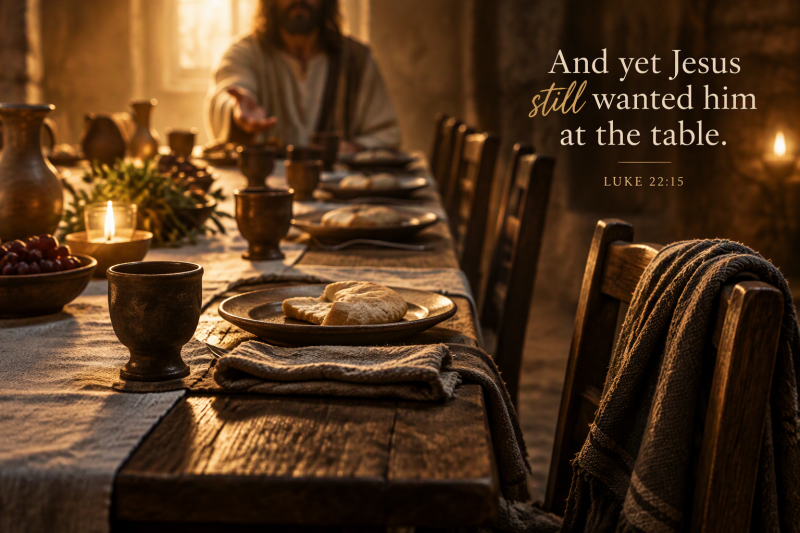
I think sometimes we read these familiar stories so often that we lose their emotional weight. We know Judas is going to betray Jesus, so we move quickly to the next scene. But pause for a moment and sit in that reality.
Imagine being Judas that night. Carrying a secret nobody else in the room knew. Smiling on the outside while darkness consumed you on the inside. Knowing what you had already set in motion.
Some of us know exactly what that feels like.
We know what it is to carry secrets. To put on a good face. To sit in church while privately fighting battles nobody knows about. To wonder if God would still want us if He knew everything.
But that's the point.
He does know everything.
Jesus knew exactly what Judas was going to do that night.
And He still shared a meal with him.
Still washed feet.
Still offered bread.
Still extended love.
Most of us struggle to be kind to someone who has hurt us in the past. Jesus showed grace to someone who was actively hurting Him in the present. He wasn't surprised by Judas's betrayal. He saw it coming and loved him anyway.
Many people assume Christianity begins when a person gets their life together. The gospel says the opposite. Jesus didn't wait for Judas to become trustworthy before extending kindness. He didn't wait for Peter to become courageous before calling him. He didn't wait for the disciples to become faithful before choosing them.
Jesus meets people where they are, not where they pretend to be.
That is not weakness. That is grace.
The more I reflected on this passage, the more I realized the story is about far more than Judas. It's about the heart of God.
The cross was never Plan B.
Jesus wasn't scrambling to recover from Judas's betrayal or the religious leaders' schemes. None of this surprised Heaven. Before the betrayal, before the arrest, before the false accusations, before the nails, there was already a plan.
A rescue plan.
Think about that for a moment. Most of us hesitate to help people when we know we'll be misunderstood, rejected, or taken for granted. Yet Jesus stepped into human history fully aware of what awaited Him. He knew the rejection, the mocking, the betrayal, and the cross were coming. He came anyway.
He knew we would reject Him.
He knew we would ignore Him.
He knew we would doubt Him.
He knew we would disobey Him.
He knew some would never believe in Him at all.
And He came anyway.
That's what makes the gospel so astonishing.

Jesus didn't go to the cross because we proved ourselves worthy. He didn't die only for those who would love Him back. His sacrifice wasn't conditioned on our obedience, our gratitude, or even our belief.
His sacrifice flowed from His character.
From His love.
From His mercy.
From His desire to save.
When I read Luke 22 now, I can't help but see a Savior who fully understood every person sitting around that table and still chose the cross. Not because they deserved it, but because they needed it.
If Jesus could sit across from Judas, knowing exactly what Judas would do in a matter of hours, and still welcome him to the table, what does that tell us about His heart toward us?
Jesus knows every failure, every doubt, every weakness, every addiction, every regret we've tried to hide. Nothing about us is a surprise to Him.
He knows the broken places we try to cover up. He knows the wounds that drive our bad choices. He knows the shame we carry and the secrets we hope no one ever discovers.
And yet He still calls us to come.
He still extends grace.
He still offers forgiveness.
He still chooses love.
The gospel is not the story of Jesus loving perfect people. It's the story of Jesus loving broken people enough to rescue them.
He loves the addict who feels trapped.
He loves the prodigal who keeps running.
He loves the skeptic full of questions.
He loves the sinner who is convinced they've gone too far.
He loves the broken ones.

Maybe you're reading this and you feel more like Judas than John. More like the prodigal than the faithful son. More broken than worthy.
Maybe you've spent years running from God. Maybe you're battling an addiction. Maybe you're carrying guilt that keeps telling you you're beyond saving.
If so, look again at the table.
Jesus knew who Judas was.
Jesus knew what Judas would do.
Jesus knew the cost.
And He invited him to sit down anyway.
That's how great the love of Christ is.
Not that He loves the cleaned-up version of us.
He loves us while we're still in need of rescue.
After all, He already knows everything about you.
And He came anyway.
Add comment
Comments